
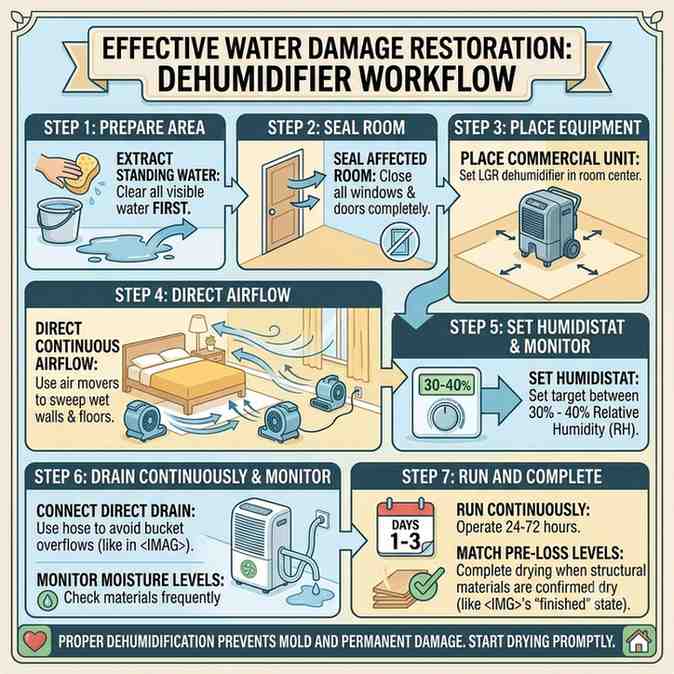
To use a dehumidifier for water damage, extract all standing water first. Seal the affected room completely by closing all windows and doors. Place a commercial refrigerant or LGR dehumidifier in the center of the room. Direct continuous airflow across wet walls and floors using high-velocity air movers. Set your humidistat between 30% and 40% relative humidity. Connect a direct drain hose to avoid bucket overflows. Run the unit continuously for 24 to 72 hours until structural materials match pre-loss moisture levels.
Now, let’s learn more about how a dehumidifier can help in water damage situations. Water damage can occur due to various reasons such as heavy rainfall, leaking pipes, or flooding. It’s important to address the issue as quickly as possible to prevent further damage and the growth of mold and mildew. A dehumidifier can be a useful tool in removing excess moisture from the air and preventing further damage. Proper use of a dehumidifier may help to reduce the drying time and prevent mold growth. It’s essential to know how to properly use a dehumidifier for water damage restoration to ensure the best results.
Table of Contents
How to Use a Dehumidifier for Water Damage: Step-by-Step Restoration Guide
Water damage strikes without warning. A burst pipe can ruin your floors in minutes. However, you can stop destruction in its tracks. When you use a dehumidifier for water damage, you protect your home. Furthermore, quick action prevents costly structural repairs.
Did you know mold grows within 24 hours? Moisture lurks inside drywall and subfloors. Standard fans only push damp air around. Therefore, you need specialized equipment to extract hidden moisture. Learning to use a dehumidifier for water damage is your best defense.
Preparation Before You Use a Dehumidifier for Water Damage
Safety comes first during water mitigation. First, turn off electricity to wet areas. Avoid electric shock hazards at all costs. Next, identify the water source. Stop active leaks before starting equipment.
Secondly, classify the water type. Clean water comes from broken pipes. Grey water contains soap or chemical contaminants. Black water from sewage demands professional hazmat gear. Consequently, never use home dehumidifiers on black water.
In addition, extract standing liquid manually. Use a wet vacuum or pump. Dehumidifiers pull moisture from air, not puddles. Removing standing water speeds up evaporation significantly.
Key Steps to Use a Dehumidifier for Water Damage Correctly
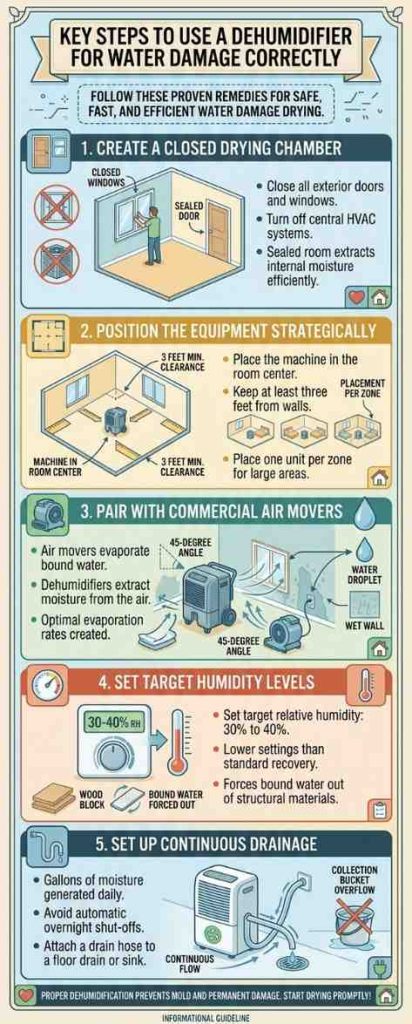
1. Create a Closed Drying Chamber
Close all exterior doors and windows. Turn off central HVAC systems. Outdoor humidity slows down indoor drying. Therefore, a sealed room forces the unit to extract internal moisture efficiently.
2. Position the Equipment Strategically
Place the machine in the room center. Keep it at least three feet away from walls. Air must flow freely into the intake vents. If flooding affected multiple rooms, place one unit per zone.
3. Pair with Commercial Air Movers
Air movers evaporate bound water from materials. Meanwhile, dehumidifiers extract that moisture from the air. Point air movers at wet walls at a 45-degree angle. This combination creates optimal evaporation rates.
4. Set Target Humidity Levels
Set the humidistat between 30% and 40% relative humidity. Standard room settings are too high for flood recovery. Consequently, lower humidity forces bound water out of wood and plaster.
5. Set Up Continuous Drainage
Water damage generates gallons of moisture daily. Internal collection buckets fill up in hours. Therefore, attach a drain hose to a floor drain or sink. Continuous draining prevents automatic shut-off overnight.
Choosing the Right Dehumidifier for Water Damage
Not all drying machines perform equally. Standard household units fail during structural floods. Consequently, restoration professionals rely on commercial-grade equipment.
| Dehumidifier Type | Extraction Method | Best Used For | Daily Water Removal Capacity |
| Standard Refrigerant | Condensation Coils | Warm, high-humidity rooms | 30 – 50 Pints |
| Low Grain Refrigerant (LGR) | Pre-cooling Air Coils | Deep structural drying below 40% RH | 70 – 150+ Pints |
| Desiccant Dehumidifier | Chemical Adsorption Wheel | Low temperatures & dense materials | 100 – 300+ Pints |
Pro Tip: According to the ANSI/IICRC S500 Standard for Professional Water Damage Restoration: Structural drying requires maintaining specific grain depression and relative humidity levels below 40% to prevent secondary microbial growth within 48 hours.
“Air movement creates moisture vapor, but only commercial dehumidification removes it from the structure permanently.”— IICRC Water Damage Restoration Field Guide
How Long to Use a Dehumidifier for Water Damage?
Most water damage restoration takes 3 to 5 days. However, drying duration depends on several critical factors:
- Material Porosity: Drywall dries faster than solid hardwood or concrete.
- Water Volume: Saturated subfloors require extended drying cycles.
- Equipment Capacity: Industrial LGR units drastically cut total drying time.
Always track progress using a moisture meter. Never rely on surface touch. Materials often feel dry while core structures remain saturated. Continue running equipment until readings match undamaged control areas.
Critical Mistakes When You Use a Dehumidifier for Water Damage
Avoid common drying errors to protect your home:
- Opening Windows: Outdoor air reintroduces humidity into your sealed chamber.
- Turning Units Off Early: Stopping equipment early allows hidden mold to bloom.
- Neglecting Filters: Clogged air filters reduce moisture removal efficiency by half.
- Ignoring Temperature Control: Keep room temperatures between 70°F and 85°F for maximum extraction.
Summary and Next Steps
Restoring flood damage requires prompt action and right equipment. When you use a dehumidifier for water damage, you eliminate hidden moisture effectively. Maintain a closed chamber, track moisture levels, and run units continuously. As a result, you save your property from costly mold remediation.
FAQs On Use a Dehumidifier for Water Damage
How many AHAM pints of dehumidification do I need per square foot for water damage restoration?
Calculate required AHAM pint capacity by dividing total room volume by the class factor of water loss. First, multiply room length, width, and height in feet to calculate total cubic volume. Second, identify your water damage class according to IICRC S500 guidelines. Class 1 water loss requires dividing room volume by 100. Class 2 requires dividing cubic volume by 40. Class 3 requires dividing cubic volume by 30. Finally, Class 4 structural water damage requires dividing total volume by 20. The resulting number represents the exact AHAM pints per day required for your restoration setup.
Should you leave the central HVAC system running while operating a dehumidifier for water damage?
Turn off your central HVAC system immediately when running a dehumidifier for water damage restoration. Central HVAC systems circulate wet air across unaffected rooms in your home. Consequently, running central air spreads hidden moisture throughout your ductwork. In addition, cold air from air conditioning reduces dehumidifier coil efficiency. Lower room temperatures cause evaporator coils to freeze up rapidly. Seal all HVAC vents using plastic sheeting and painters tape. This action isolates the wet room completely. As a result, your dehumidifier extracts moisture much faster in a controlled drying chamber.
Why is relative humidity increasing in a room with a dehumidifier running after a flood?
Relative humidity spikes initially because high-velocity air movers force bound water out of wet structural materials. Air movers evaporate liquid water trapped inside drywall, wood studs, and subfloors. This rapid evaporation floods ambient room air with hidden moisture. Consequently, air moisture content increases faster than your dehumidifier can pull water out. This spike is normal during the first 12 to 24 hours of drying. However, relative humidity will drop steadily once surface evaporation stabilizes. If humidity remains high after 24 hours, add another LGR dehumidifier immediately.
How do you set up an LGR dehumidifier for deep structural drying in hardwood subfloors?
Position an LGR dehumidifier directly beside the affected hardwood floor while sealing the entire room completely. LGR units lower vapor pressure far better than standard refrigerant models. First, place vapor barrier plastic over wet hardwood edges to concentrate drying air. Second, set up specialized floor-drying injection mats over saturated floorboards. Connect air movers directly to the injection mat system. Run the LGR unit continuously at a target relative humidity below 30%. In addition, keep ambient room temperatures between 70°F and 80°F. Maintain this configuration until subfloor moisture meters match dry reference standards.
Can you use a desiccant dehumidifier and an LGR dehumidifier together in the same drying chamber?
Do not operate desiccant and LGR dehumidifiers in the same enclosed drying chamber simultaneously. Desiccant units perform best in extremely cold temperatures and low humidity environments. Conversely, LGR units require warm air and higher grain levels to condense moisture effectively. Running both units together causes competition for available air vapor. Consequently, the desiccant unit lowers relative humidity below the operating threshold of the LGR unit. This interaction causes the LGR unit to stop condensing water altogether. Therefore, use LGR units for standard restoration and desiccant units for dense, cold materials.
How do you calculate grain depression to verify dehumidifier drying performance?
Calculate grain depression by subtracting output air grains per pound from input air grains per pound. Use a thermo-hygrometer to measure temperature and relative humidity at the dehumidifier air intake. Next, measure temperature and relative humidity at the warm exhaust outlet. Convert both psychrometric readings into Grains Per Pound (GPP) using a psychrometric chart. Subtract exhaust GPP from intake GPP to calculate total grain depression. An efficient LGR unit must maintain a grain depression of at least 30 GPP. A lower reading indicates damaged equipment or improper room sealing.
At what temperature range does a refrigerant dehumidifier lose drying efficiency?
Refrigerant dehumidifiers lose dramatic efficiency when room temperatures drop below 65°F or exceed 90°F. Below 65°F, evaporator coils frost over because condensation freezes on contact. Frost accumulation blocks airflow and stops water collection entirely. Conversely, temperatures above 90°F overload the compressor system. High heat prevents internal coils from reaching dew point temperatures needed for condensation. Therefore, keep target room temperatures strictly between 70°F and 85°F. Use auxiliary heaters in cold spaces to maintain optimal condensation rates during structural restoration.
How do you prevent secondary water damage caused by dehumidifier purge hose failure?
Prevent purge hose failures by securing all drain lines with hose clamps and elevated drainage routes. Commercial dehumidifiers utilize internal condensate pumps to purge collected water continuously. However, kinked or loose drain hoses frequently cause internal pump backups and severe secondary leaks. Always inspect the internal check valve before starting equipment. Next, anchor the discharge hose inside a secure drain line using zip ties. Route drain lines downward using gravity whenever possible to relieve pump head pressure. Finally, place secondary drip pans with automatic shutoff switches beneath every operating unit.
When should you switch from standard refrigerant to low-grain refrigerant (LGR) dehumidification?
Switch to LGR dehumidifiers when room relative humidity drops below 50% during structural drying. Standard refrigerant dehumidifiers stop extracting moisture efficiently once relative humidity reaches 40%. Consequently, bound water inside dense materials remains trapped under standard drying setups. LGR technology pre-cools incoming air before it hits evaporator coils. This unique process enables LGR units to extract moisture in dry air down to 20% relative humidity. Therefore, switch to LGR models immediately when drying hardwoods, plaster, or multi-layer subfloors.
How do you verify structural material is completely dry without trusting surface moisture meters?
Verify complete structural drying by taking deep-probe invasive readings and comparing them to unaffected dry baseline materials. Surface moisture meters only read top-layer condensation across drywall or wood. Consequently, deep subfloors and wall cavities often harbor destructive moisture unnoticed. Insert insulated pin probes directly into the center of wood framing and subflooring. Record electrical resistance moisture content readings deep inside the material core. Next, test an unaffected room in the same building to establish a dry reference standard. Structural materials are fully dry only when core readings match dry reference levels within 2% to 4%.
What Is The Role Of A Dehumidifier In Water Damage Restoration?
A dehumidifier is used to reduce moisture levels after a water damage incident. It pulls moisture from the air, preventing mold growth and further damage to walls, furniture, and carpets.
How Long Should You Run Your Dehumidifier After Water Damage?
It’s recommended to run your dehumidifier for at least 24 to 48 hours after water damage. However, the duration can increase depending on the level of water damage and humidity levels.
What Size Dehumidifier Do I Need For Water Damage Restoration?
The size of dehumidifier you need for water damage restoration depends on the square footage of the affected area. A general rule of thumb is to choose a unit that can process 10-12 gallons of water per day.
Can A Dehumidifier Be Used To Dry Out A Wet Basement?
Yes, a dehumidifier can be used to dry out a wet basement. It’s essential to remove any standing water, dry the area, increase ventilation, and run a dehumidifier. It will help to prevent mold growth and further damage.
Final Words
A dehumidifier is a powerful tool that can help you during water damage restoration. As we have discussed in this post, it is important to understand the process for using a dehumidifier properly. This is the only way to ensure that you’re able to successfully remove excess moisture from your home or office.
Remember to choose the right dehumidifier for your specific needs, and to follow the manufacturer’s instructions carefully. By controlling humidity, you can prevent mold and mildew growth, protect your belongings, and ensure a healthy living or working environment. Don’t hesitate to contact a professional if you need assistance, as they have the experience and expertise to handle even the most severe cases of water damage.
With these tips and precautions in mind, you will be well on your way to restoring your property to its pre-damage condition.