
The difference between a latte and a cappuccino is the milk-to-foam ratio. A latte uses espresso, plenty of steamed milk, and a thin foam layer. A cappuccino uses roughly equal parts espresso, steamed milk, and foam. As a result, lattes taste milder and creamier, while cappuccinos taste bolder and lighter.
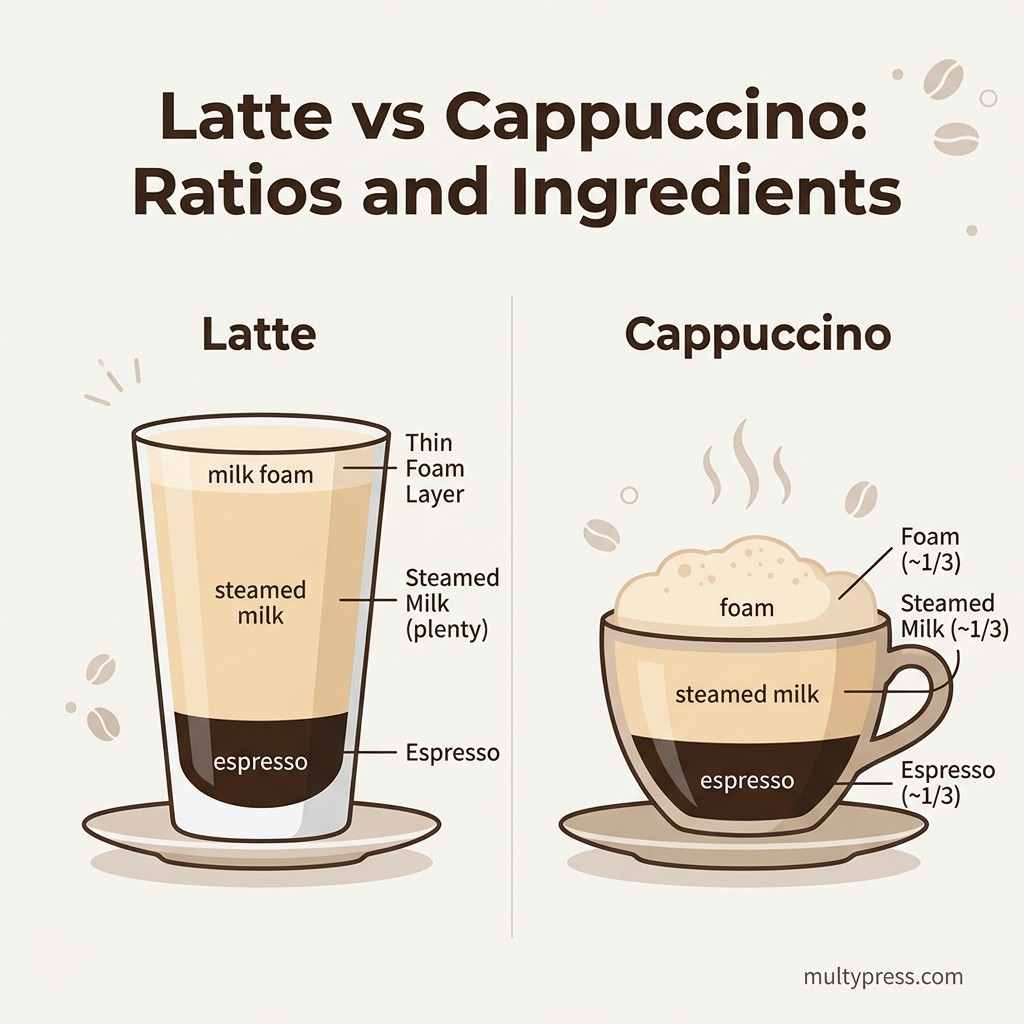
Table of Contents
Key Takeaways
- A latte contains more steamed milk, making it creamier and less intense than a cappuccino.
- Cappuccinos prioritize a distinct foam layer, often requiring a specific pouring technique to achieve the “dry” or “wet” consistency.
- Both drinks typically start with a double shot of espresso as the foundation.
- The temperature of the milk is critical, as overheating it destroys the protein structure necessary for quality foam.
- You can customize either drink with syrups, plant-based milks, or extra espresso shots to suit your palate.
What Is a Latte?
A latte is an espresso drink with steamed milk and a thin layer of microfoam. The name comes from the Italian “caffè e latte,” meaning coffee and milk. To craft a perfect latte, a barista steams milk to a temperature between 140°F and 155°F, according to National Coffee Association guidelines.
Most lattes use one or two espresso shots. Milk fills the rest of an 8- to 16-ounce cup. As a result, the flavor is mild, creamy, and slightly sweet.
Its smooth texture also makes it a favorite canvas for latte art.
What Is a Cappuccino?
A cappuccino is an espresso drink with steamed milk and a thick layer of foam. Encyclopaedia Britannica links the name to the brown robes of Capuchin friars [VERIFY year].
Traditionally, a cappuccino splits into equal parts espresso, steamed milk, and foam. Most cups are small, often five to six ounces. Meanwhile, the foam makes it feel light and airy.
Understanding the Espresso Difference
At the heart of both drinks is the espresso shot. A standard double shot is usually between 2 to 3 ounces. The quality of the espresso extraction determines the base flavor profile, whether it’s nutty, chocolatey, or acidic.
In a latte, the volume of milk is significant enough to mellow out the espresso, creating a smooth, drinkable experience. In a cappuccino, the espresso remains more prominent because there’s less liquid milk to dilute the shot, allowing the deep, roasted notes to shine through the froth.
Key Differences Between a Latte and a Cappuccino
Here’s a puzzle: both drinks can hold the same espresso. So why do they taste so different? The table has the answer.
| Feature | Latte | Cappuccino |
|---|---|---|
| Definition | Espresso with lots of steamed milk | Espresso with steamed milk and thick foam |
| Milk amount | High | Moderate |
| Foam | Thin microfoam layer | Thick, airy layer |
| Typical size | 8 to 16 oz | 5 to 6 oz, often larger in chains |
| Flavor | Mild and creamy | Bold and light |
| Caffeine | Set by espresso shots | Set by espresso shots |
| Calories | Usually higher | Usually lower |
| Best for | Slow sipping | Quick, strong coffee |
Takeaway: In short, milk volume and foam thickness set these two drinks apart.
Milk and Foam Ratio
A cappuccino divides its cup into rough thirds. A latte, in contrast, is mostly milk with a thin foam cap. The result is a velvety latte and a fluffier cappuccino.
Size and Strength
Cappuccinos usually come in smaller cups. Less milk dilutes the espresso, so the coffee flavor stands out. Lattes, on the other hand, taste softer.
Caffeine and Calories
Caffeine depends on espresso shots, not the drink name. The U.S. Food and Drug Administration says most healthy adults can have up to 400 milligrams daily. Lattes often carry more calories because they hold more milk.
Texture and Latte Art
Smooth microfoam suits latte art, such as hearts and rosettas. Thicker cappuccino foam makes designs simpler.
Comparison table summarizing Latte vs Cappuccino vs Flat White across ratio, volume, calories, caffeine, and milk texture.
Here is a complete comparison table summarizing the core differences between a Latte, Cappuccino, and Flat White across all key technical metrics:
| Metric / Attribute | Latte | Cappuccino (Traditional) | Flat White |
| Coffee-to-Milk Ratio | 1:3:1 (1 part espresso, 3 parts steamed milk, 1 part foam) | 1:1:1 (1 part espresso, 1 part steamed milk, 1 part airy foam) | 1:2 (1 part espresso/ristretto, 2 parts microfoamed milk) |
| Espresso Base | 1–2 shots standard espresso | 1–2 shots standard espresso | 2 shots Ristretto (sweeter, shorter extraction) |
| Standard Volume | 8 oz – 12 oz (240 ml – 350 ml) | 5 oz – 6 oz (150 ml – 180 ml) | 5.5 oz – 6 oz (160 ml – 180 ml) |
| Milk Texture | Silky, heavy liquid with a thin surface layer of microfoam (~0.5 cm) | Thick, light, and airy dry foam top (~1.5–2 cm cap) | Super-fine, glossy microfoam integrated completely throughout (no dry top cap) |
| Average Calories (Whole Milk) | 180 – 220 kcal | 80 – 100 kcal | 110 – 130 kcal |
| Caffeine Content (Double Shot) | ~128 mg | ~128 mg | ~128 mg (slightly lower depending on ristretto extraction time) |
| Flavor Profile | Mild, creamy, and milk-forward with soft coffee undertones | Bold, rich espresso punch cut by airy, velvet foam | Concentrated, sweet espresso flavor smoothly integrated with rich milk |
| Latte Art Capability | High (dense microfoam allows intricate poured designs) | Low (stiff, airy foam makes poured art difficult) | Moderate to High (glossy microfoam creates crisp contrast) |
Similarities Between a Latte and a Cappuccino
Both drinks start with espresso and steamed milk. Similarly, both come from a machine with a steam wand. Either one works with oat, soy, or almond milk.
Latte vs Cappuccino: Which One Should You Choose?
Picture two coworkers at the same café. One sips a latte for an hour. The other finishes a cappuccino in ten minutes.
Same espresso, different pace. Use these cues to choose:
- Beginners: Start with a latte. Its mild, creamy taste feels gentle.
- Buyers: Choose a machine with a steam wand. Without one, neither drink works well at home.
- Students: A large latte lasts through a long study session.
- Professionals: A cappuccino fits a quick meeting break.
Quick checklist:
- Want mild and creamy? Pick a latte.
- Want bold and airy? Pick a cappuccino.
Common Myths and Mistakes
Myth: A cappuccino has more caffeine. Not true. Espresso shots set the caffeine, not the drink name.
Myth: A latte is just a cappuccino with extra milk. Mostly, but the foam differs. Lattes use thin microfoam, while cappuccinos use thicker foam.
Mistake: Ordering a plain “latte” in Italy. Ask for a “caffè latte” instead.
Expert Tips
Tip: Count espresso shots, not drink names, to track your caffeine. Most healthy adults can stay within 400 milligrams daily. (Source: U.S. Food and Drug Administration, [VERIFY year])
Tip: Check milk type and syrups, because they drive most of the calories. (Source: USDA FoodData Central, [VERIFY year])
Tip: Steam milk until it’s warm, not scalding, to keep its natural sweetness. (Source: Specialty Coffee Association, [VERIFY year])
Temperature Matters
Pro Tip: Always serve your espresso drinks in pre-warmed ceramic mugs to prevent the temperature of the steamed milk from dropping too rapidly, which can cause the foam to collapse and lose its structural integrity.
Choosing Your Ideal Beverage
Selecting between these two depends largely on what you want from your coffee break. If you prefer a longer, smoother drink that pairs well with flavored syrups or serves as a morning comfort, the latte is the superior choice. If you enjoy the interplay between the warmth of the liquid and the airy, cloud-like texture of the foam, the cappuccino is the better option.
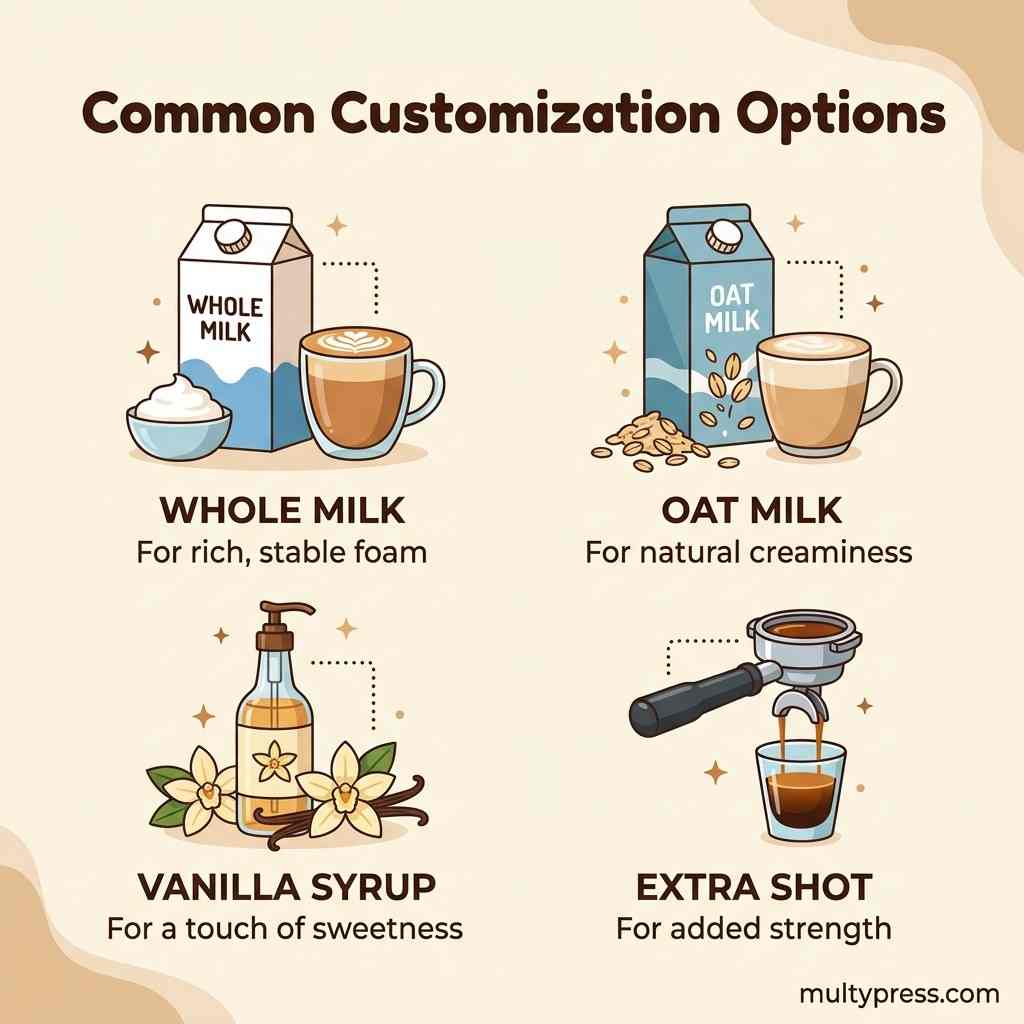
Common Customization Options
- Whole Milk: The standard choice for the best foam stability.
- Oat Milk: A popular plant-based alternative that mimics the creaminess of dairy.
- Vanilla Syrup: A classic addition for those who enjoy a sweeter profile.
- Extra Shot: Recommended if you find the milk-to-coffee ratio too weak.
Troubleshooting Your Home Brew
If your foam is disappearing too quickly, you’re likely overheating the milk. Milk proteins begin to denature above 160°F, which causes the bubbles to pop instantly. Conversely, if your foam is too “stiff” or bubbly like dish soap, you’re introducing too much air at the beginning of the steaming process.
Use a stainless steel pitcher and keep the steam wand tip just below the surface of the milk until it feels warm to the touch, then submerge it slightly to create a vortex.
FAQs Difference Between Latte and Cappuccino
What is the exact ratio of espresso, milk, and foam in a traditional cappuccino versus a latte?
A traditional cappuccino uses a strict 1:1:1 ratio of espresso, steamed milk, and airy microfoam.
In contrast, a standard latte follows a 1:3:1 ratio of espresso, steamed milk, and a thin foam cap.
Consequently, the volume and texture differ significantly between both beverages:
- Cappuccino (6 oz): 2 oz espresso, 2 oz steamed milk, 2 oz aerated microfoam.
- Latte (8–12 oz): 2 oz espresso, 5–8 oz steamed milk, 1 oz dense foam.
Therefore, the cappuccino delivers a much stronger espresso flavor per sip.
Why does a cappuccino taste significantly stronger than a latte if both use two shots of espresso?
A cappuccino tastes stronger because it contains roughly half the total liquid volume of a latte.
Both drinks contain identical amounts of coffee solids and caffeine from two espresso shots.
However, milk dilutes coffee solids directly:
- Cappuccino Dilution: 2 oz espresso diluted into only 4 oz total milk product.
- Latte Dilution: 2 oz espresso diluted into 6 to 10 oz total milk product.
Additionally, airy cappuccino foam coats your palate less than heavy liquid milk.
Thus, espresso notes punch through much faster in a cappuccino.
How does milk steaming technique differ when stretching milk for a latte versus a cappuccino?
You must incorporate far more air during the initial stretching phase for a cappuccino than for a latte.
Cappuccino foam requires double the volume expansion compared to silkier latte milk.
Follow these specific steaming parameters for each drink:
- Cappuccino Aeration: Introduce air until the steam wand tip reaches 100°F (38°C) for maximum foam expansion.
- Latte Aeration: Stop introducing air earlier at 80°F (27°C) to create fine, velvety microfoam.
- Final Temperature: Heat both milks to a final target of 140°F–150°F (60°C–65°C).
Consequently, cappuccino milk feels light, whereas latte milk pours like liquid velvet.
Does a latte contain more calories and fat than a cappuccino when using the same milk type?
Yes, a latte contains substantially more calories and fat because it uses up to double the total milk volume.
The espresso component contributes practically zero calories to either drink.
Assuming full-cream whole milk, the nutritional metrics scale with volume:
- Standard Cappuccino (6 oz): Contains approximately 80 to 100 calories and 4g of fat.
- Standard Latte (12 oz): Contains approximately 180 to 220 calories and 10g of fat.
Therefore, choosing a cappuccino significantly reduces daily caloric intake without reducing caffeine.
Why do commercial coffee shops serve giant 16oz cappuccinos when traditional Italian recipes are only 6oz?
Commercial chains expanded cup sizes to match western fast-casual beverage consumption habits.
Traditional Italian cappuccinos are breakfast drinks served strictly in 5 to 6 oz ceramic cups.
However, modern commercial sizing creates distinct structural shifts:
- Traditional Cappuccino: Highly defined layers with dry, stiff foam rising above the rim.
- Commercial Cappuccino: Basically functions as a slightly foamier, large-volume latte.
Consequently, ordering a large cappuccino in modern chains simply yields extra steamed milk.
What is the difference between a wet cappuccino, a dry cappuccino, and a standard latte?
A wet cappuccino shifts closer to a latte, while a dry cappuccino eliminates liquid milk almost completely.
Baristas adjust the ratio of liquid milk to aerated foam to alter drink texture.
Understand these three distinct preparation styles:
- Wet Cappuccino: Features 2 oz espresso, 3 oz liquid milk, and 1 oz foam cap.
- Dry Cappuccino: Features 2 oz espresso, 1 oz liquid milk, and 3 oz deep foam.
- Standard Latte: Features 2 oz espresso, 6 to 8 oz liquid milk, and minimal foam.
Thus, a dry cappuccino offers the intense roast punch of pure coffee foam.
Which drink holds latte art better, a cappuccino or a latte?
A latte holds complex latte art far better than a traditional cappuccino due to milk density.
Latte microfoam contains micro-bubbles that flow seamlessly into liquid espresso crema.
Conversely, cappuccino milk presents distinct pouring challenges:
- Latte Microfoam: Integrates smoothly, allowing detailed rosettes, tulips, and swans.
- Cappuccino Foam: Thick, stiff foam sits heavily on top, blocking precise pattern creation.
Therefore, baristas usually pour simple white central dots or heart outlines on cappuccinos.
How does the caffeine content compare between a 12oz latte and a 12oz cappuccino?
The caffeine content remains completely identical if the barista uses the same number of espresso shots.
Liquid volume changes do not alter total extracted caffeine molecules.
Consider how shot counts dictate caffeine across both beverages:
- Single-Shot Drinks: Provide roughly 63 mg of caffeine regardless of total cup size.
- Double-Shot Drinks: Provide roughly 126 mg of caffeine regardless of milk volume.
However, a cappuccino delivers that caffeine dose much faster because you consume less total liquid.
Why does the foam on a cappuccino collapse faster than the foam on a proper latte?
Cappuccino foam collapses faster because it contains larger air bubbles and less structural liquid milk matrix.
Dry foam loses trapped air rapidly as gravity pulls moisture down into the cup.
Compare the foam stability mechanisms between both drinks:
- Dry Cappuccino Foam: Large air pockets pop quickly as surface tension fails.
- Latte Microfoam: Microscopic air bubbles stay trapped inside emulsified milk fats longer.
Consequently, a latte maintains its silky top texture throughout the drinking experience.
Is a Flat White just a smaller latte or a wet cappuccino?
A Flat White is neither; it uses micro-steamed milk poured over double ristretto shots.
Ristretto extractions deliver a sweeter, less bitter coffee foundation than standard espresso shots.
Distinguish the Flat White from its counter-parts using these key metrics:
- Flat White (5.5 oz): Double ristretto, micro-steamed milk, zero stiff top foam.
- Latte (8–12 oz): Standard espresso, high milk volume, thin foam layer.
- Wet Cappuccino (6 oz): Standard espresso, mixed liquid milk, aerated foam top.
Thus, the Flat White focuses heavily on intense espresso sweetness with silky integration.
Why does oat milk foam differently in a cappuccino compared to whole dairy milk?
Oat milk lacks native dairy proteins like casein and whey, which stabilize large foam structures.
Dairy proteins stretch easily to trap air bubbles during high-aeration cappuccino steaming.
When using plant-based alternatives, expect distinct physical behaviors:
- Barista Edition Oat Milk: Uses added vegetable oils to mimic dairy foam stability.
- Standard Oat Milk: Produces thin foam that dissolves rapidly in dry cappuccinos.
Therefore, use specialized barista-grade oat milk when attempting deep cappuccino foam.
Can you make a true cappuccino or latte using a Moka Pot or French Press instead of an espresso machine?
You cannot make a true latte or cappuccino without a real espresso machine generating 9 bars of pressure.
Moka Pots and French Presses produce strong concentrated coffee, not authentic espresso with thick crema.
However, you can craft excellent “cafe-style” approximations at home:
- Coffee Base: Brew a dense concentration using a Moka Pot.
- Milk Frothing: Warm milk and pump it vigorously inside a French Press for 30 seconds.
Consequently, you achieve rich foam without expensive commercial machinery.
What is the correct temperature to serve a cappuccino versus a latte for maximum sweetness?
Both beverages achieve maximum natural sweetness when milk is steamed to 135°F–145°F (57°C–62°C).
Steaming lactose sugar past 150°F destroys natural sweetness and scalds milk proteins.
Observe how temperature impacts flavor delivery across both options:
- Optimal Range (135°F–145°F): Lactose breaks down into simpler, sweeter-tasting sugars.
- Scalded Range (160°F+): Milk loses sweetness, developing a cooked, sulfurous taste profile.
Additionally, cappuccinos cool down faster because airy foam traps less thermal mass than liquid.
Why do Italians only drink cappuccinos before 11:00 AM, but drink lattes anytime?
Italians avoid milk-heavy drinks like cappuccinos after 11:00 AM because warm milk slows digestion after heavy meals.
Italian food culture centers heavily around gut health and efficient digestion dynamics.
Understand the cultural rules surrounding milk coffee in Italy:
- Morning Routine: Cappuccinos provide energy and heavy dairy calories to start the day.
- Afternoon Routine: Italians switch strictly to straight espresso or Caffè Macchiato.
Furthermore, ordering a “latte” in Italy yields a simple glass of plain cold milk.
Which drink is better for iced preparations, a cappuccino or a latte?
A latte is far superior for iced preparations because cold milk blends smoothly with espresso over ice.
Frothed hot foam collapses instantly when poured directly over cold ice cubes.
Consider how cold temperatures affect both drink structures:
- Iced Latte: Espresso, cold liquid milk, and ice mix evenly into a refreshing beverage.
- Iced Cappuccino: Requires cold-foamed milk using specialized blenders to prevent foam collapse.
Therefore, stick with an iced latte unless the cafe offers genuine cold-foam technology.
Which drink has more caffeine?
Both drinks typically contain the same amount of caffeine because they use the same base of espresso. A standard double shot of espresso, which is used for both a latte and a cappuccino, provides a consistent caffeine kick. Unless you add an extra shot to one of them, the total caffeine content remains identical regardless of the milk volume.
Can I make these without a machine?
Yes, you can replicate the texture at home using a French press or a handheld battery-powered frother. Heat your milk on the stove, then pump the French press plunger vigorously to aerate the milk into a thick foam. While it won’t be as smooth as professional-grade microfoam, it serves as a functional substitute for a basic latte or cappuccino.
Why does my cappuccino feel lighter?
A cappuccino feels lighter in your mouth because it contains a higher proportion of air-infused milk foam. This airy structure gives the drink a fluffy mouthfeel, whereas a latte is primarily liquid milk, which feels denser and more substantial. The weight difference is primarily due to the volume of air trapped within the milk bubbles.
Is a latte healthier than a cappuccino?
Neither drink is inherently healthier, as the nutritional value depends on the type of milk used. A latte contains more total milk volume, meaning it will have more calories and protein if you use dairy or high-calorie nut milks. If you’re watching your caloric intake, a smaller cappuccino or a latte made with a lower-calorie milk alternative is a better choice.
Final Thoughts
To improve your coffee routine, visit a local specialty cafe this weekend and order both a latte and a cappuccino side-by-side. Pay close attention to the weight of the cup and the way the foam interacts with the espresso as you drink. Once you identify your preferred texture, you’ll never have to guess which option satisfies your morning cravings again.
Sources
- Cappuccino, Encyclopaedia Britannica.
- Spilling the Beans: How Much Caffeine Is Too Much?, U.S. Food and Drug Administration.
- FoodData Central, U.S. Department of Agriculture.
- Barista and milk-steaming resources, Specialty Coffee Association.