
Yes, you can safely play golf after cataract surgery. However, you must follow a structured recovery timeline. Light putting is usually safe after one to two weeks. Full, powerful golf swings require four weeks of healing. Always get formal clearance from your ophthalmologist before returning to the course.
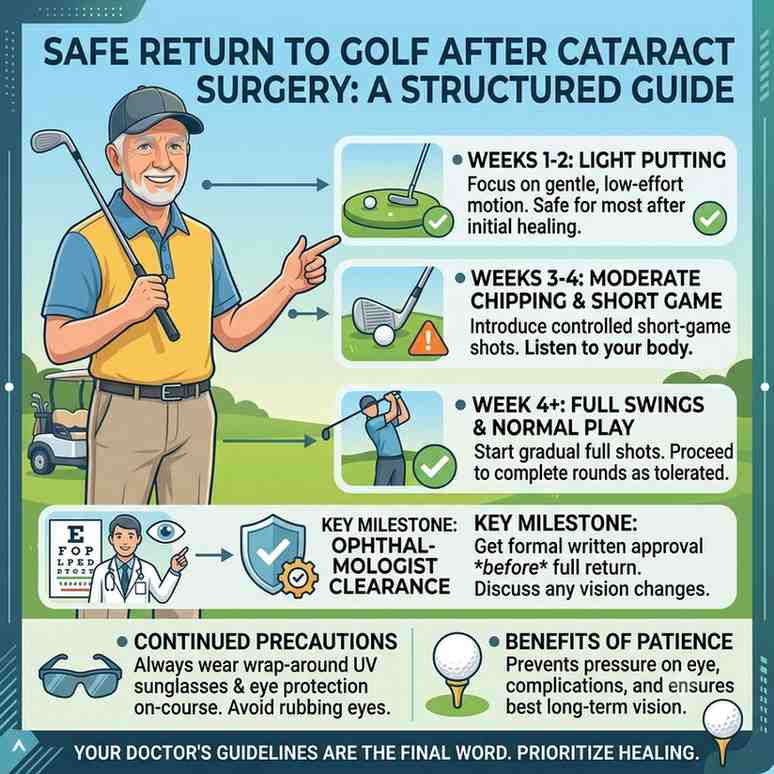
Golf is typically allowed after a certain amount of time has passed and the eye has healed properly. It’s always best to ask your doctor for specific recommendations based on your individual circumstances. Cataract surgery is a common procedure that involves replacing the cloudy lens in the eye with an artificial lens.
While it’s a routine surgery, it’s still important to take proper care of your eyes afterward to ensure a successful recovery. One common question is whether it’s safe to play golf after cataract surgery. In this article, we’ll explore the answer to this question and provide some tips for getting back on the golf course after your surgery.
Table of Contents
⛳ Golf After Cataract Surgery Recovery Timeline Calculator
Estimate when you may be ready to return to golf based on your recovery progress. This educational tool provides general guidance and should never replace your eye surgeon’s recommendations.
📅 Suggested Timeline
✅ Safety Tips Before Returning to Golf
👨⚕️ Questions to Ask Your Eye Surgeon
- Is my eye healing normally for golf activities?
- Can I safely swing a golf club?
- Should I avoid carrying a heavy golf bag?
- Is it safe to spend several hours in bright sunlight?
- Do I need protective sunglasses while golfing?
How to Safely Play Golf After Cataract Surgery: A Complete Guide
Are you eager to get back on the green after eye treatment? Many avid golfers ask if they can play golf after cataract surgery safely. The answer is a resounding yes. Modern eye surgery offers incredible visual restoration.
However, returning to the course too quickly can jeopardize your healing eyes. Cataract surgery is a delicate procedure. Your delicate eye tissue needs dedicated time to repair properly.
In this detailed guide, we explain everything you need to know. You will discover safe timelines, key precautions, and expert golfing tips.
How Cataract Surgery Improves Your Golf Game?
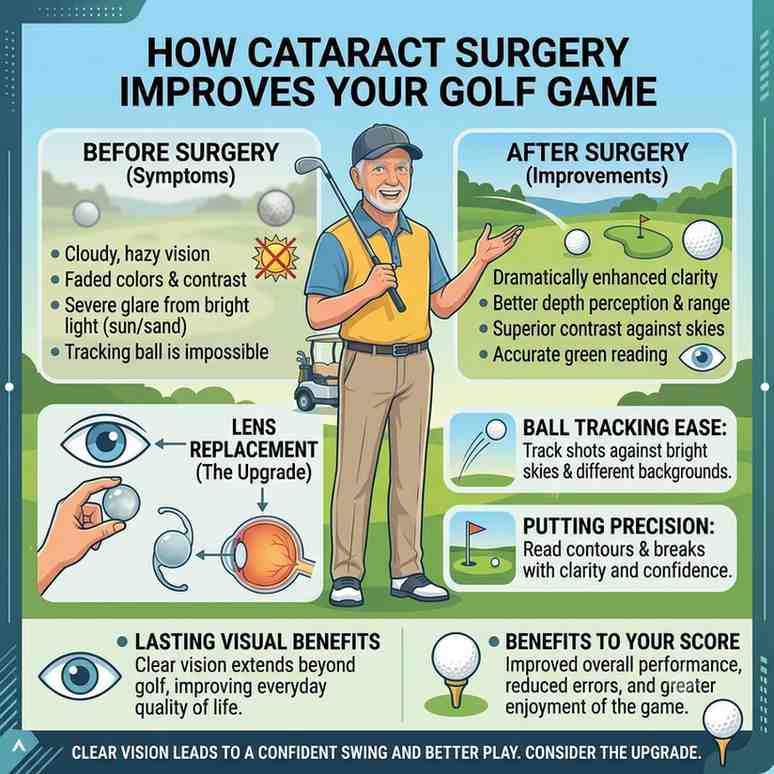
Before exploring recovery times, consider the benefits of lens replacement. Cataracts cause cloudy vision, faded colors, and severe glare sensitivity. These issues make tracking golf balls nearly impossible.
During surgery, an ophthalmologist removes your natural cloudy lens. They replace it with an artificial intraocular lens (IOL). This upgrade dramatically enhances clarity and depth perception.
Many players report seeing contrast much better after surgery. Reading putting greens becomes significantly easier. You will track high-flying shots against bright skies with ease.
Expert Insight: Over 90% of patients achieve improved vision for daily sports after surgery. This finding comes from the American Society of Cataract and Refractive Surgery (ASCRS).
Why Timing Matters When You Play Golf After Cataract Surgery?
Why do doctors strictly restrict sports after lens replacement? During surgery, your doctor creates a tiny self-sealing corneal incision. This microscopic incision heals without traditional stitches.
Physical exertion raises intraocular pressure (IOP) inside your eyeball. High eye pressure can force open the healing incision. Sudden head movements from full golf swings can also shift your new lens.
Bending over repeatedly to pick up balls strains your eye blood vessels. Sweat running into your eyes transfers harmful bacteria. Turf dust and wind can also trigger severe inflammation.
Expert Tip: Avoid any exertion that causes head throbbing or eye strain during your first two recovery weeks.
Play Golf After Cataract Surgery: Stage-by-Stage Timeline
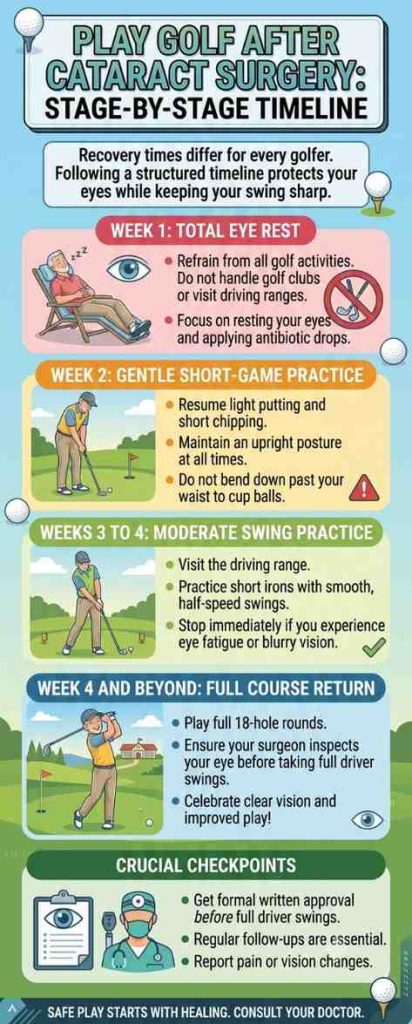
Recovery times differ for every golfer. However, following a structured timeline protects your eyes while keeping your swing sharp.
| Recovery Phase | Permitted Golf Activity | Primary Focus & Precautions |
| Week 1 | Complete Rest (No Golf) | Avoid bending, lifting heavy objects, and sweating |
| Week 2 | Light Putting & Chipping | Gentle strokes; wear sunglasses; upright posture |
| Weeks 3–4 | Driving Range Practice | Half-swings with light irons; monitor eye comfort |
| Week 4+ | Full 18-Hole Matches | Full swings allowed after doctor confirmation |
Week 1: Total Eye Rest
During the first week, refrain from all golf activities. Do not handle golf clubs or visit driving ranges. Focus on resting your eyes and applying antibiotic drops.
Week 2: Gentle Short-Game Practice
You may resume light putting and short chipping during week two. Maintain an upright posture at all times. Do not bend down past your waist to cup balls.
Weeks 3 to 4: Moderate Swing Practice
By week three, you can visit the driving range. Practice short irons with smooth, half-speed swings. Stop immediately if you experience eye fatigue or blurry vision.
Week 4 and Beyond: Full Course Return
Most golfers can play full 18-hole rounds after one month. Ensure your surgeon inspects your eye before taking full driver swings.
Environmental Hazards on the Golf Course
Golf courses present hidden risks to healing eyes. Being aware of these dangers prevents unexpected complications.
1. Intense Ultraviolet Glare
Freshly operated eyes are extra sensitive to sunlight. Direct UV exposure slows corneal healing and causes discomfort. Always wear 100% UV-blocking polarized sunglasses on the fairway.
2. Flying Sand and Turf Dust
Windy conditions blow sand from bunkers into your eyes. Fine dust particles carry bacteria into the healing incision. Protective glasses act as a physical shield against blowing airborne debris.
3. Fertilizers and Turf Chemicals
Golf courses use chemical fertilizers and weed killers. Touching grass and then touching your face introduces irritants into your eye. Wash your hands frequently during your round.
Expert Tip: Carry lubricating artificial tear drops to flush out dust and soothe dry eyes while playing.
Essential Gear Tips for Post-Surgery Golfers
Upgrading your golf gear makes your return safer and more comfortable. Consider adding these items to your bag.
Use a Ball Retriever Tool
Avoid bending over repeatedly on the putting green. A suction cup attachment on your putter grip retrieves balls effortlessly.
Wear a Wide-Brimmed Hat
A quality golf cap or visor blocks overhead sunlight. Combining a hat with sunglasses offers maximum UV defense.
Keep a Clean Towel Handy
Sweat contains natural bacteria that irritate healing eye tissues. Wipe your brow frequently to prevent sweat from reaching your eyes.
“Most golfers safely return to full swings four weeks post-surgery. However, wearing eye protection and avoiding heavy strain in early weeks is mandatory.” — Dr. Alan Rodriguez, Board-Certified Ophthalmologist.
You can definitely play golf after cataract surgery and enjoy superior visual performance. Clearer sight will boost your confidence on every hole.
However, respect the healing process and follow your doctor’s timeline. Start slow with short putts before taking full swings. Protect your eyes from sun, dust, and physical strain. Soon, you will be back playing the sport you love with crystal-clear vision.
🕶️ Outdoor Eye Protection Advisor
Get personalized recommendations for protecting your eyes outdoors after cataract surgery, during golf, walking, or other outdoor activities.
🛡️ Recommended Eye Protection
✅ Outdoor Safety Tips
⚠️ Extra Precautions
FAQs For Play Golf After Cataract Surgery
Why does bending over to address a golf ball increase intraocular eye pressure after cataract surgery?
Bending your head below your heart at address significantly spikes your intraocular pressure during early eye recovery. Gravity causes extra fluid to accumulate rapidly inside your eye anterior chamber. Furthermore, increased eye pressure can force open your unstitched corneal micro-incision. This complication delays healing and allows dangerous bacteria to enter your eye. Therefore, golfers must use a wide golf stance or squat using their legs instead. Keep your head elevated above your waist whenever you tee up or read greens.
Can the rotational torque of a fast driver swing dislodge a newly implanted intraocular lens (IOL)?
A fast golf swing will not dislodge an intraocular lens after two weeks of normal healing. However, violent head movements during the first week can shift an unanchored lens. The capsular bag takes about four weeks to shrink and permanently lock the lens. Consequently, early aggressive rotational torque can cause minor lens tilt or astigmatism shifts. Therefore, you should keep your head stable and swing smoothly at half speed initially. Always wait until your surgeon confirms full capsular bag fusion before swinging hard.
How do multifocal intraocular lenses affect a golfer’s ability to read putting greens?
Multifocal lenses can temporarily alter your depth perception and create subtle visual halos around bright hole markers. These visual artifacts occur because light splits into multiple distinct focal points simultaneously. As a result, your brain needs several weeks of neuroadaptation to judge green slopes accurately. Consequently, putting distance control may feel slightly off during your initial post-surgery rounds. You can fix this by tilting your head slightly to find the sharpest optic zone. Monofocal lenses set for distance avoid this issue, though you may need reading glasses.
Why does holding your breath during a full golf swing pose a risk to healing eyes?
Holding your breath during a heavy swing triggers a Valsalva maneuver that spikes internal eye pressure. This sudden pressure spike strains fragile blood vessels inside your healing eye tissues. In addition, increased pressure can cause micro-bleeding inside your eye’s anterior chamber. Golfers often hold their breath subconsciously during high-effort drives on the tee. Therefore, consciously exhale as you initiate your downswing through impact. Exhaling smoothly keeps your intraocular pressure stable throughout your entire golf stroke.
Is driving a golf cart across bumpy terrain safe two weeks after cataract surgery?
Driving a golf cart on rough fairway bumps is unsafe during your first two recovery weeks. Sharp jolts can cause micro-trauma to your unhealed clear corneal incision site. Additionally, sudden vibrations increase the risk of acute intraocular lens dislocation early on. If you must ride in a cart, stay strictly on designated smooth paved paths. Drive at slow speeds and avoid driving across hidden fairway ruts or tree roots. Walking gently on flat fairways offers a much safer alternative for early light exercise.
What immediate steps should a golfer take if sweat with grass fertilizer enters the eye?
Flush your eye immediately with sterile saline drops or artificial tears for at least five minutes. Never rub your eye with a dirty towel or gloved hand under any circumstances. Rubbing can reopen your self-sealing surgical incision and introduce harmful environmental bacteria. Turf chemicals can cause severe chemical keratitis or devastating endophthalmitis infections in healing eyes. After flushing thoroughly, contact your eye surgeon to check if antibiotic drops are required. Wear a high-absorbency forehead sweatband during warm rounds to prevent sweat runoff completely.
Why does golf course bunker sand present a severe infection hazard post-cataract surgery?
Bunker sand contains fine airborne silica dust and organic fungal spores that easily infect healing incisions. Swinging in deep sand traps creates dust clouds that settle directly onto your cornea. Furthermore, your eye’s natural tear barrier remains compromised during the first month of healing. Consequently, microscopic sand particles can cause corneal abrasions or severe intraocular fungal infections. Golfers should avoid playing out of bunker sand traps for at least four weeks. Take a free drop outside the sand bunker if your ball lands inside.
How does intense sunlight reflection off fairways and sand traps harm post-surgery eyes?
Reflected sunlight causes severe photophobia and corneal inflammation because your new lens lets in more light. Fresh intraocular lenses allow significantly higher light transmission than your old cloudy natural lens. As a result, bright fairway glare can cause eye strain and temporary visual blurriness. Sand bunkers and water hazards reflect harmful ultraviolet radiation directly upward into your eyes. Therefore, wear category three polarized sunglasses with 100 percent ultraviolet radiation protection while playing. Choose wraparound sunglass frames to block harsh side glare on open sunny courses.
Why do golf balls appear unusually bright or blue against the sky after cataract surgery?
Golf balls appear brighter and bluer because your new lens restores full high-energy visible blue light transmission. Natural cataracts act as yellow filters that block cool blue light wavelengths over time. Removing the cloudy lens suddenly restores vivid color saturation and dramatic visual contrast. Consequently, white golf balls stand out much clearer against green grass and blue skies. This color shift is completely normal and indicates a successful visual restoration process. Your brain will adapt fully to this enhanced color perception within a few weeks.
How can a golfer safely retrieve golf balls without bending down after surgery?
Attach a rubber suction-cup retriever to your putter grip to pick up balls without bending. Bending at your waist places your eyes below your heart level, raising pressure dangerously. Alternatively, bend your knees while keeping your torso upright and your head high. You can also ask your playing partner to tee up your golf ball safely. Using these adaptive techniques protects your surgical site while maintaining your pace of play. Continue using these posture adjustments until your doctor clears you for full bending.
Is It Safe To Play Golf After Cataract Surgery?
In general, it’s safe to play golf after cataract surgery once you’ve received the green light from your ophthalmologist.
How Soon After Cataract Surgery Can I Play Golf?
You should wait at least two weeks before playing golf after cataract surgery. This allows your eye to heal properly and reduces the risk of infection.
Can Playing Golf Damage My Eye After Cataract Surgery?
Playing golf after cataract surgery is generally safe. However, you should avoid getting hit in the eye with a golf ball or club.
Can I Wear Sunglasses While Playing Golf After Cataract Surgery?
Yes, you should wear sunglasses while playing golf after cataract surgery to protect your eyes from uv rays. Polarized sunglasses are highly recommended.
What Are Some Precautions I Need To Take While Playing Golf After Cataract Surgery?
Take the necessary safety precautions such as wearing sunglasses and avoid getting hit in the eye. It’s also important to stay hydrated and take breaks if you experience any discomfort.
Final Thought
Golf is a great sport that a lot of people enjoy playing and it’s understandable for golfers to want to continue doing so after their cataract surgery. Based on the information we’ve shared in this blog post, it is safe to say that most individuals who undergo cataract surgery can resume playing golf within a few days to weeks post-surgery.
However, some may need to wait a bit longer depending on their doctor’s advice and individual healing process. It’s important to remember that everyone’s recovery and postoperative instructions vary and that following your doctor’s instructions is key to ensuring a safe and successful recovery.
Overall, if you’re a golfer who has had cataract surgery or is thinking about having it, you can rest assured that you’ll be able to get back on the green and enjoy a round of golf in the near future.
Just be patient and take things one step at a time.