
A salvage title value reflects a vehicle’s worth after severe damage makes repair costs exceed its actual cash value. When an insurance company declares a car a total loss, the car damage cost plays the primary role in determining the final salvage payout. Understanding this connection helps you negotiate better settlements and avoid costly mistakes when buying or selling damaged vehicles.
Table of Contents
🚘 Salvage Title Value Estimator
Estimate a vehicle’s possible resale value after salvage-related depreciation, compare repair scenarios, and prepare for a more informed buying or selling decision.
📊 Your illustrative resale estimate
🧮 How the estimate was calculated
✅ Your next-step checklist
⚠️ Important considerations
💡 How to improve your estimate
Compare at least three similar vehicles in your local market. Match the make, model, trim, model year, mileage, condition, damage history, title brand, and road-use status as closely as possible.
For a major purchase, arrange an independent inspection by a qualified mechanic and, where appropriate, a body or frame specialist. Ask for repair invoices and relevant inspection records.
Disclaimer: This tool provides an illustrative estimate using your inputs and assumptions. It does not access live vehicle listings, determine the legally correct title classification, or replace a professional appraisal. A salvage title and a rebuilt title are not necessarily equivalent. Rules, inspections, insurance availability, financing, and registration requirements vary by jurisdiction. Flood, fire, structural, or unknown damage can involve serious hidden risks that a simple percentage cannot adequately measure.
Salvage Title Value: Understanding Car Damage Cost and Vehicle Worth
Have you ever wondered what happens to a car after a massive crash? Insurance adjusters do not guess numbers. They rely on precise math to determine your car's true financial standing.
Navigating the aftermath of a major auto accident feels overwhelming. Understanding your vehicle's post-accident worth protects your wallet. This comprehensive guide reveals how insurers calculate vehicle worth after severe accidents.
What Is Salvage Title Value?
A salvage title value represents the realistic market price of a vehicle that an insurance provider deems a total loss.
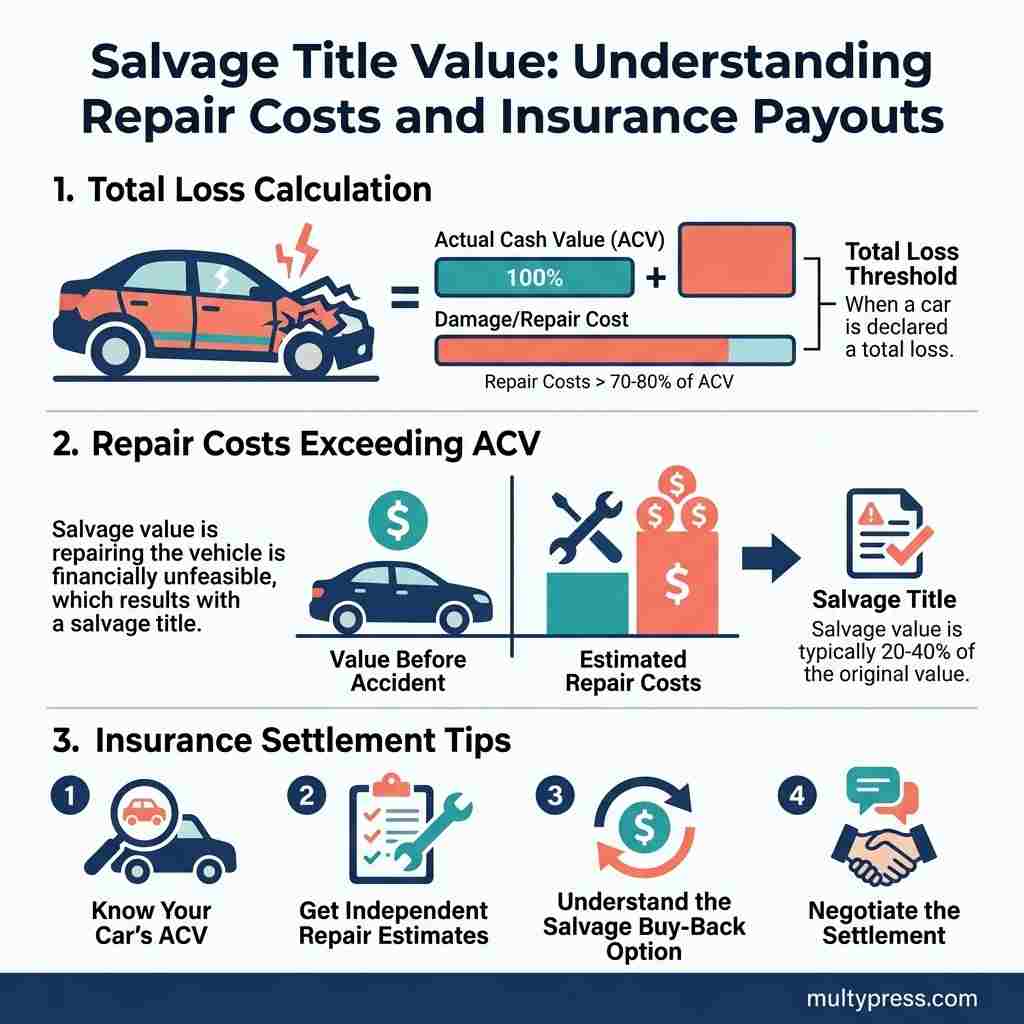
When a car suffers severe structural or mechanical harm, the car damage cost often approaches or exceeds the car's pre-accident value. State laws dictate specific total loss thresholds, typically ranging between 70% and 90% of the vehicle's fair market value. Once damage hits that line, the state issues a salvage brand.
Pre-Accident Value - Car Damage Cost = Salvage Title Value
How Car Damage Cost Dictates Vehicle Evaluation
Insurance adjusters evaluate physical destruction through detailed collision shop estimates. They calculate repair totals, parts costs, and labor hours.
Total Loss Formula:

Car Damage Cost + Salvage Value >= Pre-Accident Actual Cash Value (ACV)
If the combined costs reach the state threshold, the insurer writes off the vehicle.
"Never accept the first settlement offer from an insurer without running independent market research on identical salvage vehicles." — Auto Insurance Claims Specialist Association
Key Factors That Determine Salvage Title Value
Several critical variables influence the final price tag of a total-loss vehicle:
- Pre-Accident Condition: Exceptional maintenance records slightly boost final valuation figures.
- Extent of Damage: Structural frame damage drops resale numbers much faster than cosmetic panel damage.
- Part Market Demand: High demand for reusable components increases scrap auction bidding prices.
- Vehicle Age: Newer models retain higher scrap yields due to modern technology components.
Salvage Title Value Comparison Matrix
| Vehicle Category | Pre-Accident Value | Estimated Repair Cost | Retained Salvage Title Value |
| Compact Sedan | $15,000 | $12,000 | $3,000 |
| Midsize SUV | $28,000 | $22,000 | $5,600 |
| Luxury Coupe | $45,000 | $38,000 | $7,500 |
| Pickup Truck | $32,000 | $24,000 | $8,000 |
Calculating Your Car's Worth After an Accident
Determining realistic pricing requires a simple step-by-step approach:
- Establish Actual Cash Value (ACV): Research local market prices for similar makes and models prior to the accident.
- Obtain Detailed Repair Estimates: Gather written quotes detailing parts and labor from certified mechanics.
- Apply the 50% Rule: Most salvage vehicles sell for 45% to 55% of their pre-accident ACV.
According to data from Kelly Blue Book (KBB), a vehicle with a branded salvage title typically loses 20% to 40% of its standard market value even after complete, high-quality repairs.
Buying or Selling a Salvage Title Vehicle: Risks and Rewards
Purchasing branded vehicles offers significant upfront savings, but risks remain high.
- Lower Purchase Price: Buyers save thousands on late-model vehicles.
- Insurance Challenges: Many insurance providers refuse comprehensive coverage on branded titles.
- Resale Difficulty: Future buyers often hesitate to purchase previously totaled automobiles.
Before buying, always secure a comprehensive vehicle history report through services like AutoCheck or Carfax to verify original accident records.
FAQs On Salvage Title Value
How Do Insurance Companies Calculate Salvage Title Value During a Settlement?
Insurer adjusters determine salvage title value by obtaining live commercial scrap bids from licensed auto auction houses like Copart or IAAI.
The adjuster takes your vehicle's pre-accident Actual Cash Value (ACV) and subtracts the projected repair costs. If the remaining figure drops below local salvage auction bids for identical models, that top auction bid becomes your vehicle's baseline salvage value.
- Formula: $\text{Actual Cash Value (ACV)} - \text{Salvage Auction Bid} = \text{Maximum Insurer Repair Allowance}$.
- Key Fact: Salvage values range from 15% to 35% of the vehicle's pre-accident market value.
What Is the Percentage Difference Between Actual Cash Value and Salvage Title Value?
A vehicle slapped with a salvage brand immediately loses between 40% and 60% of its pre-accident market value.
Even if you fully repair the car to pristine mechanical condition, the permanent brand on the title severely limits future resale demand. Appraisers calculate this drop because major dealerships refuse salvage trade-ins, and banks decline vehicle loans on branded titles.
How Does the Total Loss Threshold (TLT) Affect Retained Salvage Value?
The Total Loss Threshold (TLT) is a state law mandating when an insurance provider must brand a car as salvage.
States use two main evaluation rules:
- Percentage Threshold States: States like Florida (80%) or Texas (100%) set strict percentage caps. If repair bills hit that percentage of ACV, salvage titling triggers instantly.
- Total Loss Formula (TLF) States: States like California or Georgia add repair costs directly to estimated salvage value. If $\text{Repair Costs} + \text{Salvage Value} \ge \text{ACV}$, the state forces a salvage title.
Can You Dispute an Insurance Company’s Calculated Salvage Value?
Yes, you can successfully challenge an insurance adjuster's salvage deduction by invoking your policy's formal Appraisal Clause.
Insurance adjusters frequently overstate salvage value estimates to lower their cash settlement payouts to vehicle owners. You can counter their valuation by securing certified written appraisals from independent salvage yards or local licensed mechanics.
Step 1: Request insurer's salvage bid paperwork.
Step 2: Hire an independent appraisal expert.
Step 3: Submit 3 local yard quotes to force recalculation.
How Much Cash Do You Lose by Choosing an Owner-Retention Settlement?
When you choose owner-retention, the insurance provider deducts the calculated salvage value directly from your total settlement check.
If your car's ACV is $12,000 and its salvage value is $2,500, the insurance company hands you $9,500. You keep the damaged vehicle, but you must pay out-of-pocket for repairs and state safety re-inspections.
Does a Rebuilt Title Increase the Salvage Value of a Car?
Converting a salvage title to a rebuilt title restores approximately 10% to 20% of lost market value.
A rebuilt title proves your vehicle passed rigorous state safety and structural inspections after comprehensive repairs. However, a rebuilt car will still trade for 20% to 40% less than a clean-titled equivalent model.
Why Do Salvage Title Values Drop Further for Electric Vehicles (EVs)?
Electric vehicle salvage title values crash faster because high-voltage battery packs face severe safety liabilities and disposal fees.
Most insurers default EV battery damage to a total replacement cost exceeding $15,000. Additionally, salvage yards discount damaged EVs because thermal runaway risks require costly specialized storage facilities.
How Do You Calculate Salvage Title Value for an Old Out-of-Production Vehicle?
Classic or out-of-production vehicles require historical specialized market appraisals rather than standard Kelley Blue Book (KBB) valuations.
Scrap yards value rare vehicles based on individual component scarcity rather than overall vehicle weight.
- Obtain historical auction records from platforms like Bring a Trailer.
- Itemize intact original OEM components (transmissions, trim pieces, glass).
- Multiply rare part market rates by 0.60 to establish real-world salvage value.
Can You Get Full Coverage Insurance on a Vehicle with Salvage Value?
No, national insurance companies almost universally refuse comprehensive and collision coverage on salvage title vehicles.
Insurance underwriters cannot accurately measure pre-existing damage against new accident claims on branded titles. Once you repair the vehicle and earn a Rebuilt Title, select specialty insurers will write liability-only policies.
What Role Does Scrap Metal Pricing Play in Baseline Salvage Title Value?
Scrap metal market pricing creates the absolute minimum financial baseline for any salvage vehicle value.
When vehicle components suffer complete structural destruction, scrap yards appraise the car strictly by gross tonnage weight. Shredded steel and aluminum prices fluctuate daily based on global commodity market demands.
How Does Water and Flood Damage Impact Salvage Title Value Calculations?
Flood damage destroys salvage value far more aggressively than mechanical or cosmetic front-end collisions.
Corrosive salt or fresh water damages hidden electronic modules and wiring harnesses continuously over time. Consequently, salvage yards bid significantly lower prices on flooded cars because electrical components cannot be resold safely.
Are Dealer Trade-In Values Affected by a Previous Salvage Title?
Major franchised auto dealerships routinely reject trade-in offers on branded or rebuilt salvage titles.
Independent used car lots that accept salvage trade-ins typically offer wholesale prices 50% below clean market rates. Dealerships cannot sell branded titles to traditional buyers requiring credit union financing.
How Do Frame Damage Ratings Lower a Car’s Salvage Title Value?
Unrepaired unibody frame damage triggers the steepest drop in vehicle salvage value outside of total structural fires.
Bent frame rails compromise vehicle crash safety zones and prevent correct wheel alignment setup. Salvage auction buyers heavily discount frame-damaged units due to the massive structural bench labor fees required to pull metal back into specification.
Can You Use GAP Insurance to Cover the Salvage Title Value Gap?
GAP insurance covers the financial difference between your primary insurer's ACV settlement and your remaining auto loan balance.
However, GAP policies will not cover salvage value deductions if you choose owner retention. If you keep the wrecked car, you remain personally responsible for the salvage value gap deducted by your primary insurer.
Where Can You Find Historical Salvage Auction Data to Verify Vehicle Value?
You can cross-reference historic salvage auction sale results through specialized auto data aggregators like AutoBidMaster, CarDataIndex, or BadVin.
These public databases track historical bidding price trends from major wholesale salvage auctions across the country. Reviewing actual final bids for matching damage profiles gives you concrete leverage when negotiating settlements with insurance adjusters.