
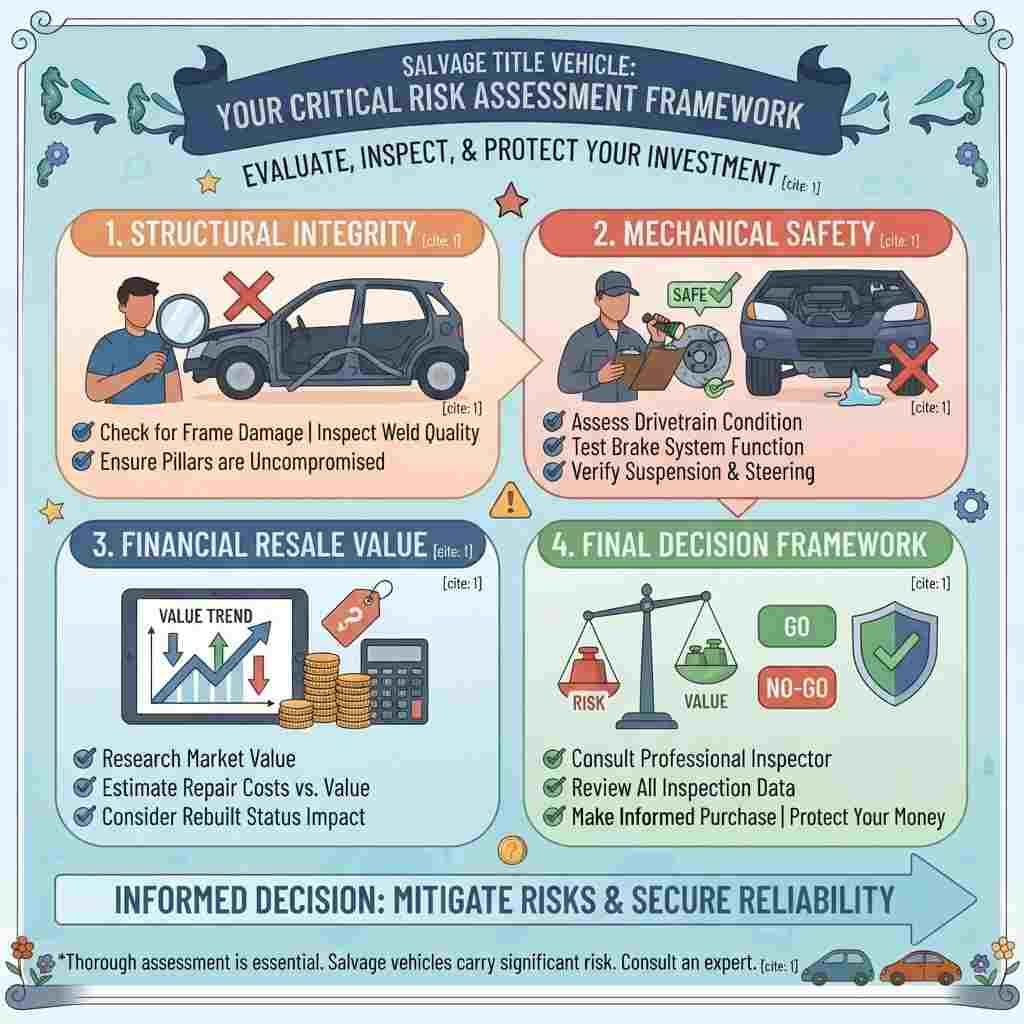
Buying a salvage vehicle can save you thousands of dollars, but it carries hidden dangers that trap inexperienced buyers. Salvage title risk assessment is the critical process of evaluating a total-loss vehicle’s structural integrity, mechanical safety, and financial resale value before purchase. Without a rigorous inspection framework, you risk buying a dangerous money pit. Follow this expert-backed framework to protect your hard-earned money and secure a reliable ride.
Salvage Title Risk Assessment Quiz
Answer these questions to identify potential risks before buying a salvage-title vehicle.
The Salvage Vehicle Evaluation Matrix
Understanding the condition and risk level of a branded title car requires comparing different damage classifications. The table below outlines how various loss types impact your long-term ownership safety and resale potential.
| Damage Type | Average Repair Cost | Structural Risk Level | Resale Depreciation Impact |
| Flood Damage | Moderate to High | Low to Moderate | Severe (Electrical Issues) |
| Collision Damage | High | Critical (Frame/Chassis) | High |
| Hail/Vandalism | Low | None (Cosmetic Only) | Low to Moderate |
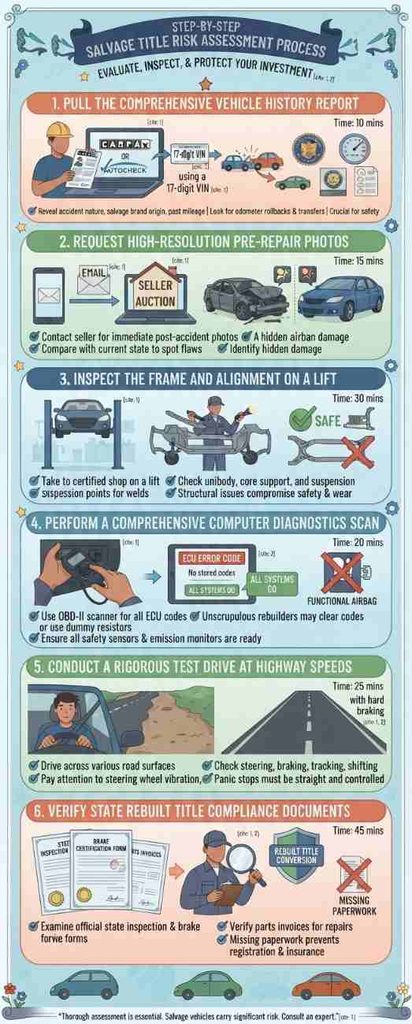
Step-by-Step Salvage Title Risk Assessment Process
Accurately evaluating a totaled car requires strict adherence to a sequential roadmap. Skipping any of these steps can lead to severe financial loss or dangerous mechanical failures on the highway.
Step 1: Pull the Comprehensive Vehicle History Report [Time: 10 mins]
Start by obtaining an official report from providers like Carfax or AutoCheck using the unique 17-digit VIN. This initial check reveals the exact nature of the accident, the state that issued the salvage brand, and past mileage records. Look specifically for odometer rollbacks and multiple previous owner transfers. Never skip this step, because hidden flood histories or multiple severe wrecks destroy vehicle safety.
Step 2: Request High-Resolution Pre-Repair Photos [Time: 15 mins]
Contact the seller or auction house to secure photos of the vehicle taken immediately after the accident occurred. Sellers sometimes hide airbag deployments or frame compression under cheap cosmetic body panels. Compare these crash photos directly with the current state of the car to spot unaddressed structural flaws.
Step 3: Inspect the Frame and Alignment on a Lift [Time: 30 mins]
Take the vehicle to a certified mechanic shop and place it on a professional hydraulic lift. Inspect the unibody rails, core support, and suspension mounting points for welds, kinks, or uneven gaps. Professional mechanics state that structural misalignment compromises future crash protection and causes uneven tire wear.
Step 4: Perform a Comprehensive Computer Diagnostics Scan [Time: 20 mins]
Plug an OBD-II scanner into the vehicle port to read all engine control unit (ECU) error codes and module statuses. Unscrupulous rebuilders sometimes clear diagnostic trouble codes or install dummy resistors to fake functional airbags. Ensure all safety sensors, ABS systems, and emission monitors report ready states without stored fault codes.
Step 5: Conduct a Rigorous Test Drive at Highway Speeds [Time: 25 mins]
Drive the vehicle across various road surfaces, including local rough patches and fast highway stretches. Pay close attention to steering wheel vibration, brake pull, tracking straightness, and abnormal transmission shifting behavior. Always test the brakes firmly on an empty road to verify that panic stops do not cause dangerous pulling.
Step 6: Verify State Rebuilt Title Compliance Documents [Time: 45 mins]
Examine all official state inspection receipts, brake certification forms, and parts invoices used during the vehicle restoration. Insurance companies and local DMVs require strict documentation before converting a salvage certificate into a legal rebuilt title. Missing paperwork will prevent vehicle registration and legal insurance coverage.
Why Step 3 (Frame Inspection) is the Most Critical: The structural skeleton of a car absorbs impact energy during a collision. If the frame was poorly straightened or improperly welded during rebuild, the vehicle offers zero protection in a secondary crash, turning a minor fender-bender into a fatal catastrophe.
Broader Context and Expert Insights
Navigating the market for branded vehicles demands extreme patience and skepticism. Industry veteran mechanics frequently emphasize that initial savings disappear rapidly if hidden mechanical ghosts emerge weeks after purchase.
“A cheap salvage car is only a bargain if the repair work matches factory safety specifications down to the millimeter,” notes master automotive technician Marcus Vance. “Never trust cosmetic perfection until you verify what lies underneath the paint.”
When budgeting for a rebuilt vehicle, remember that traditional lenders often restrict auto loans for branded titles. Most major insurance carriers will only offer liability coverage or charge higher premiums due to the unknown integrity of the car. Always consult your insurance agent beforehand to secure quotes and ensure smooth policy issuance. By following this expert assessment protocol, you minimize financial exposure and drive away with confidence.
FAQs About Salvage Title Risk Assessment
Can you get full coverage insurance on a car with a salvage or rebuilt title?
Most major insurance companies refuse to offer comprehensive and collision coverage on branded titles. They only provide basic liability insurance because calculating the exact pre-accident value of a rebuilt car remains extremely difficult. Independent specialty insurers sometimes offer full coverage, but they demand official inspection reports and detailed repair receipts first. Expect to pay higher premiums and face lower payout limits if another accident occurs.
How much does a salvage title reduce a vehicle’s market resale value?
A salvage or rebuilt title typically slashes a car’s market value by twenty to forty percent compared to clean-title equivalents. Future buyers fear hidden structural damage, electrical glitches, and lack of warranty protection. Dealerships usually reject branded cars entirely or offer rock-bottom trade-in prices. You must plan to drive the vehicle into the ground to recoup your initial financial investment.
Will a standard pre-purchase inspection reveal hidden frame damage from a salvage rebuild?
Standard visual inspections often miss subtle frame misalignments hidden underneath fresh undercoating or interior panels. You need a specialized mechanic who uses a dedicated frame-measuring machine and a hydraulic lift. Always request laser measurement printouts to verify that the chassis dimensions match factory specifications down to the millimeter. Skipping this specialized check leaves you vulnerable to dangerous handling and uneven tire wear.
What is the difference between a salvage title and a rebuilt title?
A salvage title simply means an insurance company declared the car a total loss after an accident, theft, or natural disaster. You cannot legally drive a salvage-branded vehicle on public roads or purchase standard insurance coverage. A rebuilt title means the car underwent complete repairs and passed a rigorous state-mandated safety inspection. Once it passes, the state issues a rebuilt brand that allows legal registration and driving.
Are flood-damaged salvage cars riskier to buy than collision-repaired vehicles?
Flood-damaged cars carry much higher long-term risks than physical collision repairs because water destroys modern automotive electronics. Moisture corrodes wiring harnesses, causes intermittent sensor failures, and triggers mold growth inside closed dash cavities. These electrical ghosts can appear months after purchase and often cost more to diagnose than the car’s actual worth. Avoid saltwater flood vehicles entirely because corrosion spreads silently through every metallic component.
Do manufacturers honor remaining factory warranties on vehicles with rebuilt salvage titles?
Original equipment manufacturers void all powertrain and bumper-to-bumper warranties the moment an insurance company brands a vehicle as salvage. Even if the car is fully rebuilt with original factory parts, the manufacturer takes zero liability for subsequent mechanical failures. You must rely entirely on third-party aftermarket warranties, which frequently reject claims involving prior total-loss history. Always budget for out-of-pocket repair costs when purchasing branded vehicles.
How do you verify if airbags were properly replaced after a salvage collision?
Unscrupulous rebuilders sometimes install cheap dummy resistors into steering wheels instead of expensive new airbag modules. You must plug an advanced OBD-II diagnostic tool into the car to check active SRS module health. Furthermore, a certified body shop technician must physically remove trim panels to inspect airbag igniters and sensors. Never trust dashboard warning lights alone, because shady sellers often wire warning bulbs into other circuits to hide faults.
Can you finance a car purchase if it carries a salvage or rebuilt title?
Traditional banks and credit unions strictly refuse auto loans for cars with salvage or rebuilt titles. Lenders view branded vehicles as high-risk assets that lack reliable collateral value. Buyers must typically pay cash in full or secure personal unsecured loans with significantly higher interest rates. Always confirm your financing source before placing any bids at online salvage auctions.
What documents do you need to register a rebuilt salvage vehicle at the DMV?
You need the original salvage certificate signed over to your name, an official state inspection certificate, and official brake/lamp adjustment forms. Additionally, the DMV requires original purchase receipts for every single replacement part used during the vehicle restoration. Missing even one major parts invoice will halt your registration process and prevent legal road use indefinitely. Always check your local state DMV guidelines before starting any rebuilding project.
Are cars bought from salvage auto auctions sold with any kind of warranty?
Salvage auctions sell every single vehicle strictly on an “as-is, where-is” basis with zero guarantees or warranties. Auction houses do not test engines, transmissions, or electrical systems before the hammer falls on your bid. You cannot return a vehicle if you discover catastrophic mechanical damage after taking delivery. Always factor heavy repair contingencies into your maximum bidding budget to avoid financial disaster.